

Trying to get started in Beijing again
I should have been much more prepared, considering I’ve been planning for my return to Beijing since August 2008, the minute I returned home from my first study abroad to China. I was curious and nervous with excitement when I stepped off the plane, mostly though I was tired and couldn’t wait to crash on anything slightly resembling a bed. I was surprised how easily I made it from the airport to my hotel, never once having to carry my heavy assortment of bags all at once. The drive was fast and safe, the taxi drivers actually stayed in their lanes and use their blinkers, and for a random Tuesday night at 7:00 pm there was surprisingly little traffic in Beijing.
The next morning I was eager to get the dirty work of registration out of the way, but I was slowed way down when I realized I had to wire money in order to pay tuition, so the whole process was put on hold as I waited half a day in a bank line. Today, however, the sun is shinning, and I’m up much earlier ready to search for apartments, register for class, and most importantly to have more patience and realize I may not accomplish anything today, but that’s o.k. at least I can see some blue sky.
The next morning I was eager to get the dirty work of registration out of the way, but I was slowed way down when I realized I had to wire money in order to pay tuition, so the whole process was put on hold as I waited half a day in a bank line. Today, however, the sun is shinning, and I’m up much earlier ready to search for apartments, register for class, and most importantly to have more patience and realize I may not accomplish anything today, but that’s o.k. at least I can see some blue sky.
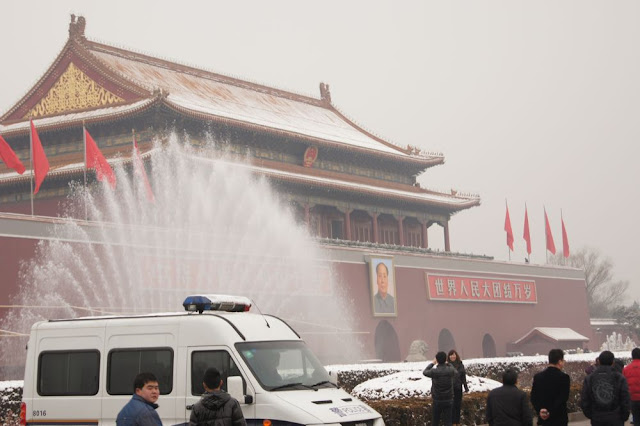
Everything happens quickly in Beijing
Everything happens quickly in Beijing. Buildings pop up left and right, the subway is constantly expanding (there are now 13 lines), countless Chinese citizens from the western part are seeking jobs in the city, more and more foreigners visit and are even making China their home, and more foreign companies are also investing more time and effort into Beijing, resulting in a exciting yet tumultuous scene of young and old, new and outdated, as well as eastern and western cultures all colliding in one spot.
The other day I was walking down the street to meet my friend for lunch and on the way I noticed some workers stripping a bill board advertisement (it was hard not to notice since they blocked the entire sidewalk, forcing the numerous number of pedestrians to cut into heavy street traffic for half a block). On my way back an hour later, expecting to encounter this minor delay on my return trip, I was shocked to notice the sidewalk was completely cleared and the billboard ad changed. These minor changes are happening all over Beijing and having a major effect on the overall face and progress of the city. In some sense it is good, as Beijing is becoming a more international city, global brands are readily available making it comfortable for all foreigners to visit and foreign businesses continue to be intrigued by the Chinese cheap labor market and desire for growth. However, it is also easy to argue this quick yet haphazard development is not what’s best for China. While it may bring a surge of jobs and better quality of living for some, it’s important to keep in mind what was there before the giant IKEA and Wal Mart moved in. As shiny skyscrapers quickly replaces crumbling apartment buildings and historic hutongs around Tiananmen are knocked down in place of fancy government housing, this means opportunity for some but for the majority of middle to lower class Chinese it means they are pushed out of certain neighborhoods (which were originally theirs) and eventually Beijing will become a socially segregated and stratified city. This of course is a burden for most ‘western’ and ‘modern’ cities (not to confuse western as anything analogous with modern) but perhaps Beijing should re-think or start to actually systematically plan its development. China makes it clear they want to carve their own future but they seem to be heading down a similar path as many western cities, so I would caution them to take a breather and build their city with more conscious intentions before erecting more sky-scrappers, railways, and roads. After all, it is from the ancient Chinese philosophies that we learn about the ying and yang, the importance of a balanced lifestyle. Heeding their own ancient philosophies might be China’s best path if they actually applied it to their next stages of growth.
Subscribe to:
Posts (Atom)